Resources
 Feature overview

For those who frequently use proxy IPs, overseas networks, cross-border e-commerce accounts, or social media accounts, "Is the IP clean?" has always been a major concern.
There are many IP detection websites available online; some focus on online IP lookups, others primarily look at IP reputation, and some can identify proxy IPs, but each tool has a different focus.
Today, let's take a look at the best IP purity detection tools for the second half of 2026. Which ones are better suited for checking proxy IP purity? Let’s help everyone avoid unnecessary pitfalls.

1. What is IP Purity Detection?
IP purity detection checks the "historical performance" and "risk attributes" of a public IP in the internet environment. "Pure" here does not mean the IP is absolutely risk-free, but rather a comprehensive judgment on whether it has obvious proxy characteristics, abuse records, or blacklist records.
Comprehensive IP detection now usually focuses on IP attribution, ISP/ASN, residential or data center attributes, proxy identification, risk scores, and blacklist records simultaneously.
Some tools further detect DNS leaks, WebRTC leaks, and browser fingerprints, allowing users to determine whether the "IP is the problem" or if the entire network environment is inconsistent.
2. IP Detection Sites worth using in H2 2026?
To check proxy IPs, it is recommended to use tools that provide IP risk, proxy type, and network environment information.
1. ToDetect: Suitable for general users doing comprehensive checks
ToDetect is worth mentioning first. It doesn't just tell you "where your IP comes from," but focuses more on IP quality and the actual network environment.
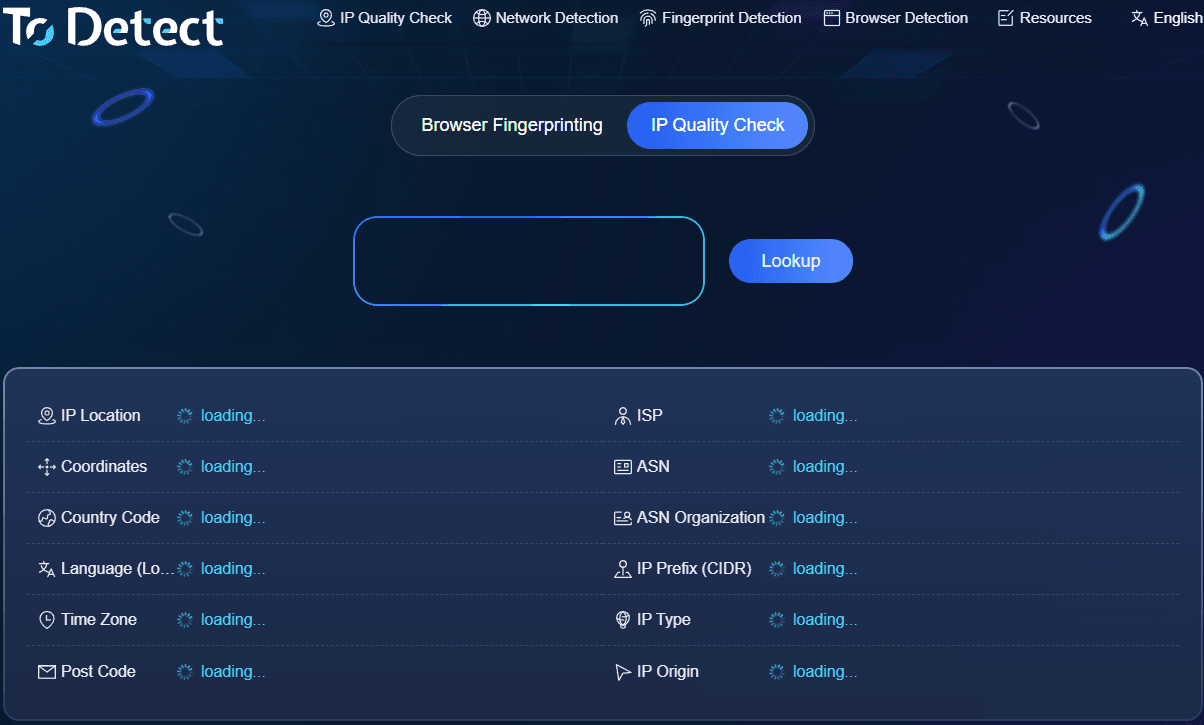
Currently, you can view IP quality scores, browser fingerprint consistency, as well as the IP address's corresponding time zone, language, system, browser, etc. It also provides DNS and WebRTC-related detection capabilities.
In terms of usage barriers, ToDetect’s advantage is its intuitive nature, making it suitable for general users who are not familiar with IP databases and risk control indicators. It has also recently launched dedicated content and tools for IP purity detection.
2. Scamalytics: Better for those concerned with IP risk scores
If you are particularly concerned about whether an IP carries fraud risk, try Scamalytics.
Its positioning is more towards fraud risk identification and IP reputation analysis. It can assign risk scores to IPs while determining whether they are proxy servers.
These tools are quite meaningful for scenarios like e-commerce, payments, registration, and risk control. However, note that risk scores are not a "universal platform standard."
3. IPQualityScore: Suitable for IP reputation and proxy identification
IPQualityScore (IPQS) is also a common IP risk detection service.
It provides IP reputation and proxy detection capabilities, offering analysis from perspectives like proxy identification and IP reputation. It also offers APIs for developers.
If you only need to check an IP temporarily, you can use the web tool directly; for enterprises needing batch IP detection, consider the API. However, do not blindly trust any single score.
4. IPinfo: Very convenient for basic IP information lookup
IPinfo is more focused on IP data and developer tools. If your need is mainly online IP lookup, such as viewing country, region, ASN, ISP, or network attribution, it is quite suitable.
Its advantage is not necessarily giving you a simple "clean/unclean" conclusion, but providing more basic network information. For developers, data analysts, and those who need to judge IP attributes themselves, this data is quite valuable.
3. Comparison of IP Purity Detection Tools for H2 2026
| Rank | Detection Tool | IP Purity | Proxy IP Check | Risk Score | DNS / WebRTC | Overall Recommendation |
|---|---|---|---|---|---|---|
| 🥇 1 | ToDetect | ★★★★★ | ★★★★★ | ★★★★★ | ★★★★★ | ★★★★★ |
| 🥈 2 | Scamalytics | ★★★★★ | ★★★★★ | ★★★★★ | — | ★★★★☆ |
| 🥉 3 | IPQualityScore | ★★★★☆ | ★★★★★ | ★★★★★ | — | ★★★★☆ |
| 4 | IPinfo | ★★★☆☆ | ★★★☆☆ | ★★★☆☆ | — | ★★★★☆ |
| 5 | IP2Location | ★★★☆☆ | ★★★☆☆ | ★★★☆☆ | — | ★★★☆☆ |
| 6 | WHOER | ★★★★☆ | ★★★★☆ | ★★★☆☆ | ★★★★☆ | ★★★★☆ |
| 7 | WhatIsMyIPAddress | ★★☆☆☆ | ★★☆☆☆ | ★★☆☆☆ | — | ★★★☆☆ |
4. IP purity cannot be judged by a single score
Seeing a website show an IP quality score of 90 makes one think the IP must be great; seeing another website show high risk makes one think the IP cannot be used. In reality, IP purity is a comprehensive concept.
When performing IP purity detection, it is best to look at at least the following indicators:
First, look at the IP type. Confirm whether it is a residential IP, mobile IP, data center IP, or proxy IP. Different businesses have completely different requirements for IP types.
Second, look at whether the IP attribution is consistent. Information regarding country, city, ISP, ASN, and the provider should ideally align with each other.
Third, look at risk and blacklist records. If the IP has obvious historical records of spam, attacks, or abuse, it is not recommended for important business even if the geographic location is correct.
Fourth, look at DNS and WebRTC. Especially when using proxy IPs, only changing the public IP while allowing real network information to leak through DNS or WebRTC can still lead to environmental inconsistency.
5. How should proxy IP purity be tested?
If you have just purchased a batch of proxy IPs, it is not recommended to judge them one by one by "feeling." A more practical method is to establish a fixed proxy IP detection workflow.
Connect to the proxy first, then perform an online IP query to confirm whether the IP address, country, city, and ISP meet your purchase requirements; then use comprehensive tools like ToDetect to check IP quality, proxy attributes, and DNS/WebRTC status; then perform a cross-verification using Scamalytics or other IP reputation tools.
If the results given by several tools are basically consistent, it means the IP at least does not have any obvious issues at the level of public databases. Conversely, if one website shows it as a residential IP while another shows it as a data center or high-risk proxy, do not rush to put it into business use; it is best to conduct further testing.
Summary
IP detection is not about pursuing a pretty-looking score, but about discovering problems in advance. ToDetect is suitable for users who want to "test multiple dimensions at once."
IP purity is not "the higher the score, the better," and there is no single detection website that can cover the judgment criteria for all platforms. The reliable approach is to choose tools based on your specific use scenario and then perform cross-detection across multiple dimensions.