Resources
 Feature overview

 Ganesh
 2026-07-07 11:12
Many people worry after purchasing a proxy IP: Has this IP been used by someone else before? Has it been flagged by websites? If it is used directly for account registration, will it trigger restrictions or account bans?
In fact, this concern is not unnecessary. Whether a proxy IP can be used stably mainly depends on its "cleanliness". Many users hesitate to use proxy IPs immediately even after purchasing them.
Today, we will show you how to verify proxy IP quality through three simple steps, helping you quickly determine whether the IP you have is worth using.

Step 1: Use Online IP Lookup to confirm whether the basic IP information is normal
After obtaining a proxy IP, do not use it immediately. It is recommended to perform a basic information check first. Many proxy IPs appear cheap and abundant, but may have issues such as abnormal IP ownership, incorrect location, or unsuitable IP types during actual use.
Through online IP lookup, you can view basic information about the current IP, including the country, city, ISP, network type, and IP range details.
For example, if you purchased a US residential proxy IP, but the lookup result shows that the IP belongs to an overseas data center instead, or the actual location does not match the provider's description, then the quality of this IP needs further evaluation.
The main information usually checked includes IP location; ASN organization; network provider information; whether it belongs to a data center IP; and whether it shows proxy server characteristics. These basic details help users quickly determine whether the proxy IP is genuine.
In addition, many people only focus on IP location when performing an IP lookup but ignore the IP type. In reality, different businesses have different requirements for IP types.
For example, account operations and social media management usually focus more on the authenticity of residential IPs, while web testing and public data collection may focus more on IP quantity and stability. Therefore, when checking IP information, you should not rely on a single indicator but evaluate multiple factors together.
Step 2: Use proxy IP detection to check IP risk history
Many proxy IP problems are not visible from basic information but are hidden in historical usage records. Some IPs may have been heavily used by many users, accessed sensitive websites frequently, or involved in abnormal activities. Although they may still connect normally, they may already carry risk labels.
These types of IPs often cause issues such as frequent CAPTCHA challenges during website login, failed account registrations, advertising platform review failures, abnormal e-commerce access, and reduced data collection efficiency.
Professional detection tools usually check: whether the IP belongs to a proxy server; whether the IP is blacklisted; whether the IP has a history of malicious activity; whether the IP reputation score is normal; and whether it has been flagged by security databases.
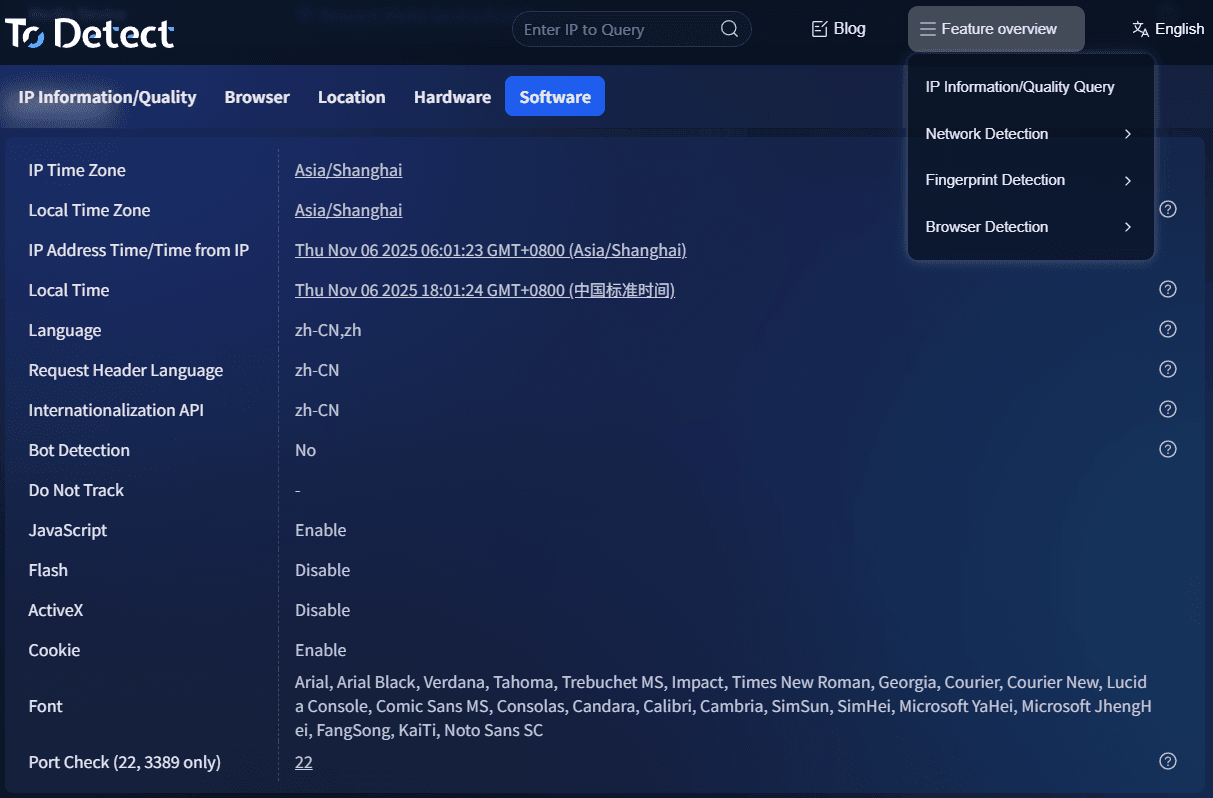
For example, professional detection services like ToDetect can analyze IP quality from multiple perspectives and help users determine whether a proxy IP is suitable for long-term use.
Of course, different businesses have different requirements for "clean" IPs. Some users only need temporary access to overseas platforms and have lower requirements, but for account registration, store operations, or long-term business environments, IP risk detection is extremely important.
Key points of Proxy IP Detection for different business scenarios
| Usage Scenario | Key Metrics to Monitor | Common Issues | Recommended Testing Direction |
|---|---|---|---|
| Cross-border E-commerce Store Operations | IP location matching, stability, historical reputation | Login issues, store risk control, increased verification requests | Focus on IP location lookup and IP risk detection |
| Overseas Social Media Account Management | IP cleanliness, proxy identification, reuse frequency | Account restrictions, login alerts, operation failures | Check IP purity test results and IP reputation score |
| Data Scraping Operations | IP quantity, access stability, blocking risks | Request failures, access frequency limitations | Focus on proxy IP availability rate and risk level detection |
| Advertising Campaign Testing | Location accuracy, network environment authenticity | Incorrect ad display, inaccurate data results | Monitor IP geolocation and network type detection |
| Website Security Testing | Anonymity level, access stability | Inaccurate test results, IP blocking issues | Check proxy attributes and IP security status |
| Market Research & Analysis | Geographic coverage, IP availability rate | Incomplete data collection, restricted access | Evaluate overall IP quality and availability duration |
Step 3: Perform IP cleanliness detection to evaluate overall IP value
The first two steps focus on checking IP information and risk status. The final step is a comprehensive IP cleanliness test. It is not simply about whether the IP can connect, but about evaluating the overall value of the IP.
First, the IP should have a clean historical record.
If an IP has been used normally for a long period without abnormal access behavior, it usually has higher trust from target websites.
Second, the IP should not show obvious proxy characteristics.
Some websites identify proxy servers. If an IP belongs to a public proxy node, the success rate of access may decrease.
Third, the IP should have a high reputation score.
Some detection systems evaluate IP risk based on multiple databases. A more stable score indicates a healthier usage environment.
Fourth, the IP should have good stability.
A clean IP should not only have low risk but also provide stable connections. Frequent disconnections or rapid IP changes can affect actual business performance.
Many users only focus on price and quantity when purchasing proxy IPs while ignoring IP quality. In reality, a stable and clean proxy IP is often more valuable than a large number of low-quality IPs.
Why should proxy IPs always be tested before use?
Many users believe that since they have already paid for proxy IPs, the provider should have already handled everything and they can use them directly.
However, proxy IP resources come from different sources and usage environments vary. Even from the same proxy provider, IP quality may differ depending on the purchase time.
Especially for overseas account registration, cross-border e-commerce operations, search engine data collection, advertising tests, website access testing, and market research analysis, a stable and reliable network environment is essential.
Therefore, before official deployment, using online IP lookup, proxy IP detection, and IP cleanliness testing to filter IP quality is highly recommended.
How to choose a reliable IP Online Detection Tool ?
There are many IP detection tools available, but the accuracy of results varies. When choosing a tool, pay attention to several key aspects.
First, check whether the detection dimensions are comprehensive.
A good detection tool should not only provide IP address and location information but also offer risk analysis, proxy identification, and reputation scoring.
Second, check the update frequency of the data.
IP risk data changes frequently. If the detection database is not updated regularly, the reference value of results will decrease.
Finally, check whether the operation is convenient.
For ordinary users, complicated technical operations are unnecessary. A simple and intuitive detection page is more practical. Platforms like ToDetect help users quickly understand IP status and obtain detailed IP quality information through simple queries.
Conclusion: Decide whether to use a proxy IP only after testing
The quality of a proxy IP cannot be judged only by price, nor should it rely solely on the provider's claims. The actual performance depends on the network environment, historical records, and current risk status behind the IP.
By using online IP lookup to understand basic information, proxy IP detection to identify potential risks, and IP cleanliness testing to evaluate overall value, you can more accurately select reliable proxy IPs.
After understanding the IP status clearly, deciding whether to use it can help the proxy IP perform better and make future business operations more stable and secure.