Same Proxy IP, Different Result: Why Your Account Gets Banned?
Learn how IP purity and Fraud Scores impact account safety. Discover residential vs. datacenter IPs, fix DNS leaks, and prevent bans in cross-border ops.
When engaging in cross-border e-commerce, social media account management, or web scraping, proxy IPs are indispensable tools.
However, many operators face a common dilemma: why do other people's accounts thrive using the exact same proxy service, while their own accounts get restricted or permanently banned right after logging in?
The core of the issue often isn't whether you're using a proxy, but whether the IP's "purity" and "disguise quality" meet the platform's risk control requirements.
Core Difference: What Is a Truly "Clean IP"?
Many beginners assume that as long as the IP shows an overseas location, it's good to go. This is actually the biggest misconception.
No Bad Record: A clean IP typically refers to an IP address with a low historical risk, no history of mass abuse, and low risk scores across major security databases. If an IP was previously used for policy-violating activities, it lands on blacklists.
Low Abuse Score: Professional detection tools evaluate an IP's Fraud Score and Abuse Score. Higher scores indicate a greater probability of anomalies in risk databases, making it far more likely to trigger platform anti-fraud mechanisms.
Exclusivity: The biggest issue with shared IPs is that you cannot control what other users do with them. If a large volume of suspicious activity originates from the same exit node, the reputation of the entire IP suffers. For strict platforms like TikTok, using dedicated native residential IPs is crucial.
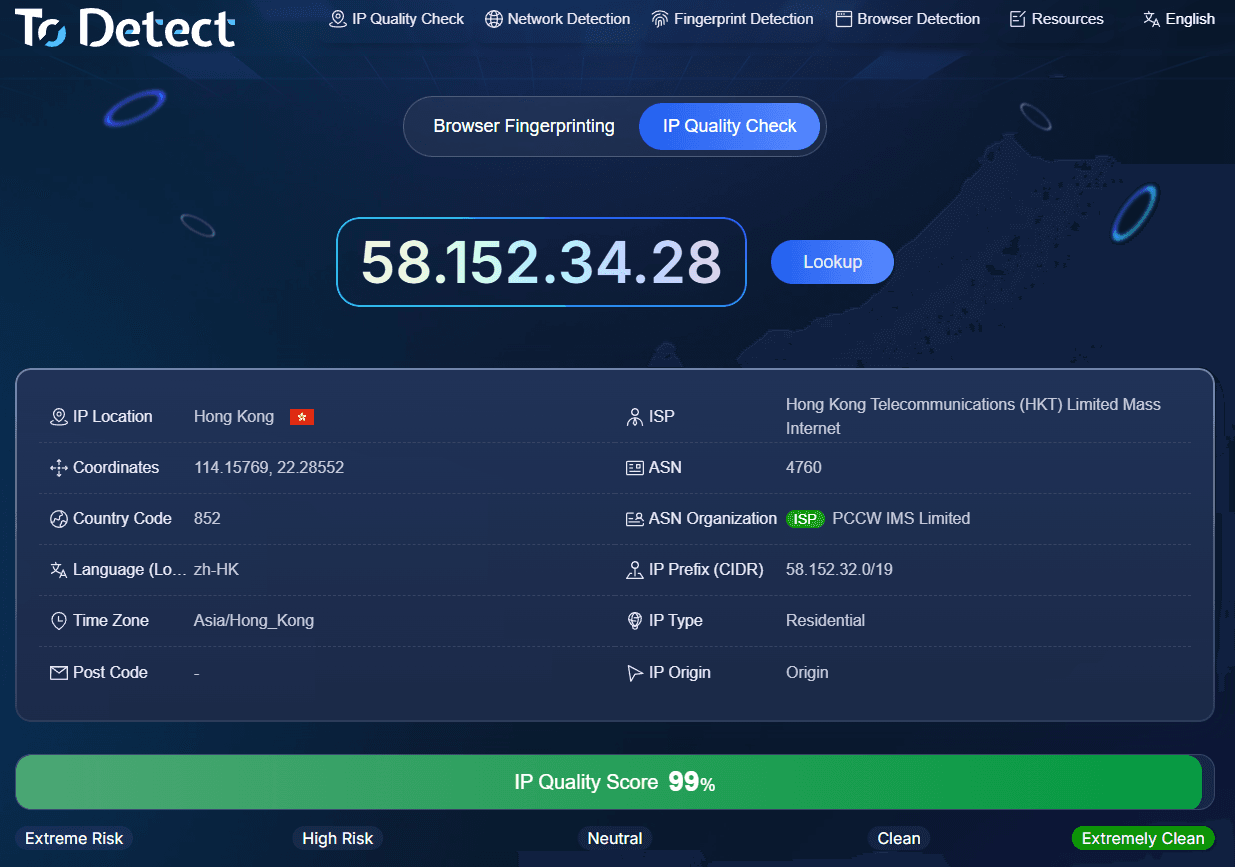
To perform a deep check on your IP quality, visit the ToDetect IP Quality Checker to get professional quality scores.
How IP Types Impact Account "Trust Weight"
Platforms do not treat all IPs equally. Based on their source, IPs fall mainly into two categories:
Residential IPs (ISP): Assigned by local Internet Service Providers. In scenarios requiring simulated real-user environments—such as account management or social media marketing—residential IPs carry much higher trust.
Datacenter/Hosting IPs (IDC): These IPs are cheap and offer high bandwidth. However, strict platforms can easily detect their datacenter origin and impose restrictions when combined with other risk signals.
Easily Overlooked Environment Consistency Issues
Account bans are rarely caused by the IP alone; environment consistency plays a massive role. Even with a top-tier IP, discrepancies in the following details can lead to failure:
DNS & WebRTC Leaks: If your IP appears to be in the US, but your DNS reveals your actual location, it flags environmental anomalies and triggers additional security checks.
Timezone & Language Alignment: Settings like timezone and system language should properly match the IP's target region to avoid persistent abnormal setups.
Browser Fingerprint Consistency: "Digital fingerprints"—including Canvas, WebGL, hardware concurrency, fonts, and more—are key methods platforms use to identify users. If multiple accounts share highly similar fingerprints, it can easily trigger cross-account suspension.
Common Misconceptions in IP Testing
Checking location while ignoring IP purity: This is a common beginner mistake. Verifying location is merely the first step; checking blacklists and risk ratings is far more critical.
Testing an IP once and assuming it stays clean: Dynamic IPs need to be retested whenever they rotate to ensure the newly assigned address remains clean and usable.
Frequently Asked Questions (FAQ)
Q1: What are the consequences of using a low-purity IP?
The most immediate impacts include shadowbanning/reach restrictions, constant CAPTCHA prompts, login failures, or outright permanent account bans.
Q2: Are static IPs inherently cleaner than dynamic IPs?
Not necessarily. Purity depends entirely on whether the IP has been abused in the past, regardless of whether it's static or dynamic. If a static IP was previously used for spam or policy violations by a prior user, it can still end up blacklisted.
Q3: How can I tell if my IP is a residential IP or a datacenter IP?
You can use detection tools to inspect its ASN organization and network type.
If it shows as "Hosting" or "IDC", it's a datacenter IP. If it displays as "ISP", it originates from an Internet Service Provider network and mirrors a genuine residential user environment.
Q4: Why can't I access certain websites even though my IP location shows correctly?
This usually happens because the IP has a high Fraud Score or because the target website detected proxy signatures or DNS leaks.
Q5: What is the most vital anti-ban strategy for managing multiple accounts?
The core principle is achieving complete "environment isolation." This involves using high-quality residential proxies, dedicated antidetect browsers, and verifying consistency across IP quality, timezone, language, and browser fingerprints using professional tools.
To learn more technical details on IP testing and network environment optimization, feel free to visit ToDetect.




 Resources
 Feature overview
 Ganesh
 2026-07-21 12:05