Resources
 Feature overview

 Ganesh
 2026-07-30 11:52
In today's world of growing digital business and cross-border trade, IP risk score has become a key indicator for measuring the credibility of online identities.
Whether for e-commerce operations, account protection, or anti-fraud risk control, understanding an IP's health status is essential.
This article explains how to check an IP risk score, the core factors influencing it, and how to evaluate environmental risks in proxy networks.
How to Check an IP Risk Score
An IP Risk Score is a quantitative assessment calculated by algorithm models using multi-dimensional IP data.
It is usually presented as a risk score or specific risk category tags.
1. Scoring Models and Evaluation Mechanisms
Note that different IP detection platforms use varying scoring models.
Common formats include a 0–100 risk score or intuitive risk level tags.
Specific threshold judgments should be evaluated based on each platform's rules.
ToDetect IP Quality Score Risk Tiers
Very Clean: Highest quality, typically clean residential IPs.
Clean: Low risk, suitable for most business scenarios.
Neutral: Average quality, may carry minor risk flags (e.g., around 67% in the example rating range).
High Risk: Displays clear anomalous signals; exercise caution.
Very High Risk: Highly likely to be a blacklisted IP, malicious proxy, or heavily polluted node.

"Low risk" does not guarantee a genuine "residential IP." Even residential IPs can be marked high risk if misused or heavily shared.
Conversely, compliant data center IPs with clean histories can maintain good reputation scores.
2. Key Output Elements
A professional IP risk detection tool provides more than just a single score. It also includes:
Risk Tags: Clearly identify specific risk factors, such as "Proxy Service Features," "Blacklist Records," or "High-Frequency Requests."
Network Attributes: Basic information like ASN ownership, IP node type (Data Center/Residential ISP), and geolocation.
What Factors Affect an IP Score?
An IP score is dynamic and continually updated based on multiple underlying dimensions.
1. IP Type and ASN Ownership
This is a baseline dimension used by risk control systems:
Residential ISP IP: Typically sourced from home broadband networks. They align closely with real user behavior in risk control models.
IDC/Data Center IP: Centrally managed and frequently used for automated tasks. They often draw higher scrutiny for actions like registration or login.
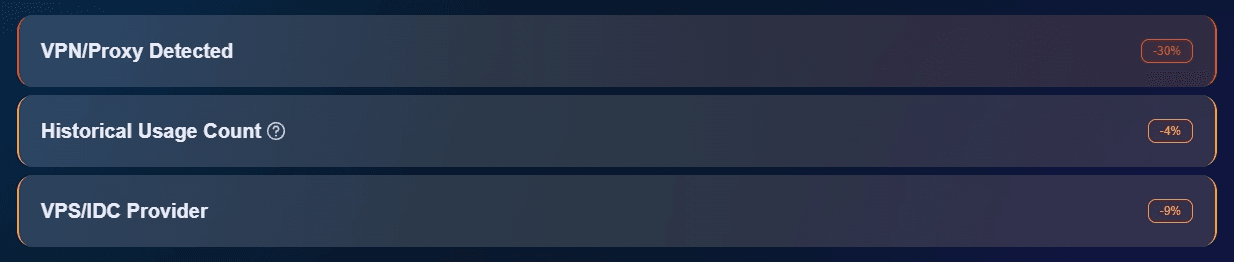
2. Anonymous Proxy Features (Proxy / VPN / Tor)
Risk systems detect whether an IP belongs to known public VPNs, open proxies, or Tor exit nodes in real time.
Using these tools significantly increases an IP's risk rating, as they are often used to conceal true network origins.
3. Historical Blacklists and Event Records
If an IP has been involved in spamming, automated attacks, or listed in security databases (like AbuseIPDB or Spamhaus), its reputation drops.
Historical records can linger; even after malicious activity stops, some security databases retain records for a period.
4. Network Consistency and Environmental Checks
While the IP score evaluates node properties, advanced risk systems also analyze client-side environment context:
Environment Consistency: Checks for DNS or WebRTC leaks that might expose true network details.
Timezone & Location Mapping: Identifies mismatches between the IP location and device timezones or language settings.
5. Node Sharing and Reuse Frequency
In shared proxies or high-reuse environments, if multiple users issue concurrent or high-frequency requests from the same IP, risk systems raise its monitoring level and lower trust scores.
Additional Insight: IP Risk Score vs. IP Purity
These two concepts are often confused:
IP Risk Score: An overall risk outcome from risk control models, factoring in blacklists, proxy characteristics, and abnormal behavior.
IP Purity: Refers to historical usage quality and sharing levels. High purity means fewer users, clean history, and no flags in risk association databases.
How to Quickly Test a Proxy IP's Risk Level
Follow this simple process to evaluate an IP's health:
Get IP Information: Open a professional IP detection tool.
Check ASN and Ownership: Verify if the IP is Data Center (IDC) or Residential (ISP).
Identify Proxy Status: See if Proxy, VPN, or Tor flags are active.
Review Blacklists: Check for entries in public security databases.
Verify Environment Consistency: Run client-side checks for DNS or WebRTC leaks.
Summary and Recommendations
Monitoring IP risk in real time supports informed decision-making in cross-border business, account management, and security.
To check current or target proxy risk status quickly and accurately, visit the ToDetect IP Checker Tool.
It offers IP lookup, proxy detection, risk scoring, and environment consistency checks to help you identify risks in your network setup.
Frequently Asked Questions (FAQ)
Q1: Why is my new proxy IP flagged as high risk?
The IP may belong to a heavily monitored range, or a previous user conducted automated requests or violations that left a historical risk mark.
Q2: Does IP risk score affect browsing speed?
The score itself doesn't reduce physical bandwidth.
However, high-risk IPs trigger frequent CAPTCHAs, rate limiting, or connection blocks, which slow down your experience.
Q3: Are IP scores 100% accurate?
No. Risk detection relies on probability and multi-factor analysis; no tool is 100% accurate.
Scores should be evaluated alongside device fingerprints and behavioral patterns.
Q4: How can I choose a lower-risk IP environment?
Opt for reputable proxy providers with transparent sources, avoid heavily shared public proxies, and ensure client settings (timezone, language) match the IP location.