Resources
 Feature overview

When connecting to the internet, a device typically uses an IP address for external communication. What is known as an "IP Risk Score Lookup" mainly relies on public data and network reputation information.
It performs a comprehensive evaluation based on the IP's historical logs, network type, ISP, and other relevant signals, using a risk score or risk level to help users assess the reputation status of their current network egress point.
It is important to note that IP risk scoring does not evaluate an individual user, but rather analyzes the network egress point itself. Because different lookup services utilize different data sources and calculation algorithms, it is entirely normal for the same IP to yield varying results across different tools.

1. What Exactly Does an IP Risk Score Lookup Check?
1.1 Risk Scores Focus on Network Outlets
An IP address can be understood as the network address used when a device connects to the internet. A risk lookup focuses on whether there are known anomaly records associated with this address itself, rather than identifying the user behind the IP.
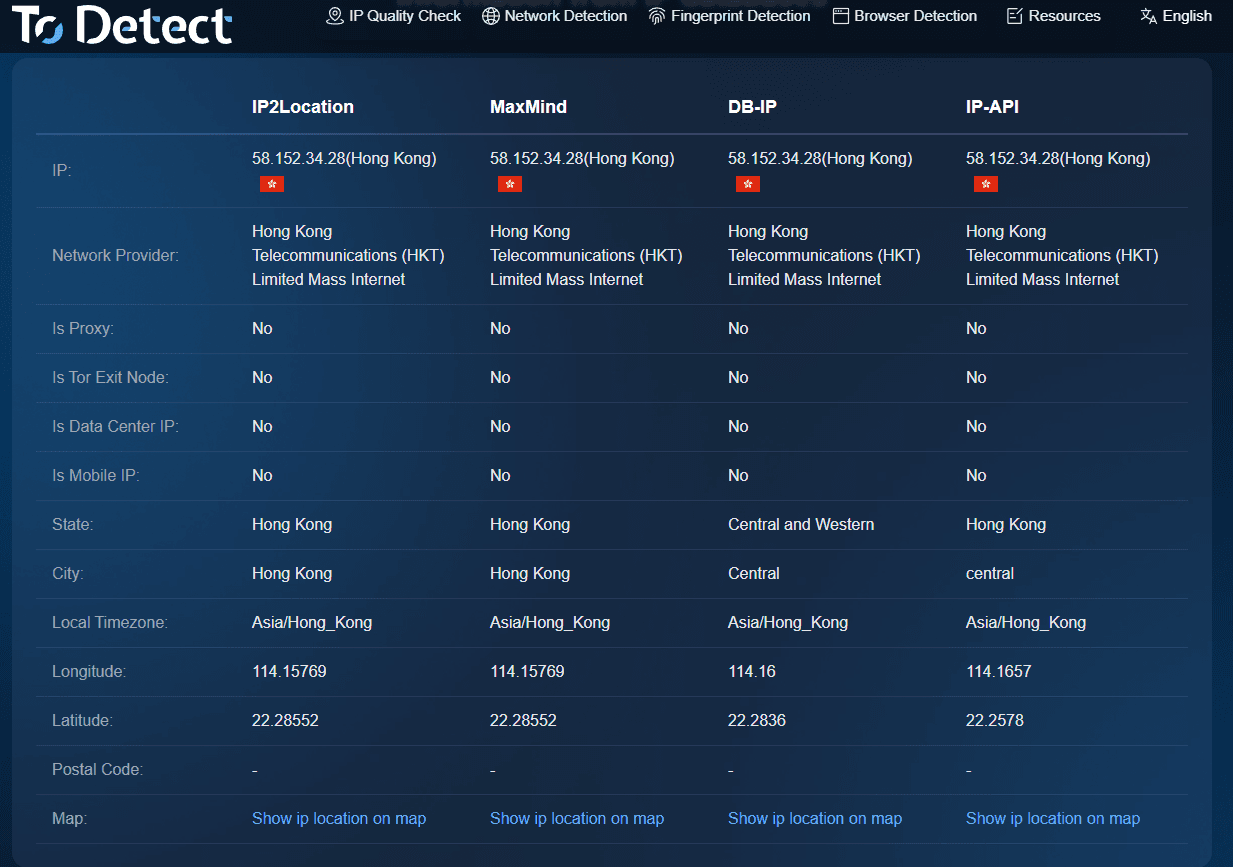
For instance, an IP may belong to residential broadband, an enterprise network, or a data center. Lookup results usually provide further details such as ISP, ASN, network type, and geolocation.
Therefore, when viewing a risk score, you should not rely on the number alone; it should be judged alongside the IP type and specific risk tags.
1.2 What Information Does IP Reputation Typically Include?
• Blacklists or Abuse Logs: Whether the IP appears in public databases related to spam, network abuse, or malicious activity;
• IP Type: Residential network, corporate network, data center, etc.;
• ISP / ASN Details: Which ISP owns the IP and which Autonomous System (AS) it belongs to;
• Historical Reputation: Whether there is a history of persistent anomalous activity or abuse logs;
• Geolocation and Network Ownership: Consistency among registration records, ISP information, and physical routing.
If you want to understand what kind of network your current exit point uses, you can combine IP detection tools to inspect the IP type, carrier, and ownership details.
2. How Is an IP Risk Score Calculated?
2.1 There Is No Universal "IP Risk Score Formula"
This is a crucial point to understand regarding IP risk values.
There is currently no standardized calculation formula adopted by all lookup platforms. Different providers use their own data sources, databases, and evaluation models; thus, the score for the same IP may vary significantly across different tools.
Simply put, think of the risk score as a synthesized result of multiple signals: Risk Score ≈ Network Reputation + IP Type + History Logs + Network Ownership + Other Risk Signals.
This is merely a simplified model to help understand the scoring logic, not an exact formula used by any specific provider.
2.2 Blacklists and Abuse Records
Public databases like DNSBL and RBL keep records of IPs associated with spamming, network abuse, and related activities.
If an IP is flagged across multiple reputation databases, certain risk assessment systems may raise its risk rating accordingly.
However, being listed on a single blacklist does not mean the IP currently poses an active threat. Database update frequencies, inclusion criteria, and false positives can all impact results, so it is best evaluated alongside specific log details.
2.3 IP Type and Network Ownership
Risk evaluations also factor in the network category to which the IP belongs.
Residential networks, corporate networks, and data center networks serve different usage scenarios, so some scoring systems apply different evaluation logic based on IP type. However, the IP type alone does not directly determine whether the risk is high or low.
For instance, a data center IP does not automatically imply high risk, nor does a residential IP guarantee a clean history free of abuse logs.
Therefore, rather than making simplistic judgments like "which type of IP is inherently safer," it is much more valuable to inspect the actual network type, ASN, ISP, and historical reputation details.
2.4 Historical Log Reference
If an IP remains stable over a long period with no significant abuse records, its reputation score tends to be steady and clean.
Conversely, if an address frequently appeared in spam feeds, abnormal connection logs, or other network abuse databases, risk systems may assign it a higher risk level.
3. What Is Considered a High IP Risk Score? How Should You Interpret It?
3.1 Scores from Different Platforms Cannot Be Directly Compared
Some services represent risk levels using a score from 0 to 100, while others grade IPs as Low, Medium, or High.
Even when two platforms both use a 0–100 scale, their internal scoring logic can be completely different.
As such, treating "30", "50", or "70" as a universal industry threshold across all tools is not recommended. The proper approach is to read the platform's own scoring documentation first, and then examine which specific risk factors were triggered.
3.2 Why Do Lookup Results Differ for the Same IP?
There are three main reasons for discrepancies:
First, Data Sources. Different services subscribe to different blacklists, reputation databases, and network intelligence feeds.
Second, Update Frequency. One platform may have updated to the latest IP records, while another still retains older historical data.
Third, Scoring Weights.
Some platforms heavily weigh blacklist inclusions, whereas others evaluate a balance of IP type, ASN, and historical reputation. When encountering differing results, focus on comparing the specific issues flagged by each tool rather than just comparing final scores.
3.3 A High Risk Score Does Not Mean the IP Is Definitively Malicious
A risk score serves as a network reputation reference rather than a final verdict on an IP. If a lookup indicates elevated risk, check the following details:
• Is it flagged in relevant reputation databases?
• What type of network does the IP belong to?
• Are the ISP and ASN normal?
• Are there historical abuse records?
• Do different lookup tools return consistent flags?
Evaluating these indicators comprehensively is far more reliable than relying on a single numerical score.
4. What Other Network Environment Information Can Be Inspected Beyond IP?
4.1 DNS Status and Resolution
An IP lookup only reveals part of the network egress story.
DNS is a vital component for resolving domain names on your device. If your DNS queries route through a resolver inconsistent with your current IP network environment, detection discrepancies may arise.
Therefore, when performing environment diagnostics, it is beneficial to check DNS routing paths and DNS provider details simultaneously.
4.2 Browser Environment Information
Browsers expose essential environmental parameters such as User-Agent, WebGL, Canvas fingerprints, and installed fonts. While these parameters do not directly constitute risk, they offer valuable context for understanding your browsing setup.
4.3 Consistency Across IP, Time Zone, and System Language
Another intuitive check involves verifying alignment among IP geolocation, device time zone, and system language settings.
For instance, a mismatch between the IP location and device settings does not necessarily signal a threat, but reviewing them together provides a complete overview during network auditing.
Summary:
Truly assessing an IP's risk requires reviewing a combination of factors: IP Risk Score + Blacklist Records + IP Type + ISP/ASN + Historical Reputation + DNS Info + Browser Environment.
If you need to check details regarding your network exit point, you can use ToDetect to perform comprehensive network environment diagnostics—inspecting IP risk details, network ownership, DNS status, and browser fingerprint parameters all in one place.
While risk scores offer a quick overview, detailed risk tags and detection breakdowns deserve closer inspection. This holistic approach provides a much clearer picture of your overall network environment than relying on a single risk score alone.