



 Resources
 Feature overview
 Ganesh
 2026-09-10 10:26
Many people running an IP risk score check encounter a situation where the blacklist checks show completely clean, with no obvious abuse records detected, yet the resulting IP risk level remains very high. Is the detection result inaccurate?
In fact, blacklists are only one indicator used to assess IP quality. Many online IP detection platforms no longer just ask "does this IP have a history of violations?" when analyzing an IP; instead, they evaluate it across multiple dimensions.
Today, let's explore why an IP with no blacklist records can still have a high risk level, which factors are most likely to drive up the risk score, and how to interpret online IP detection results accurately.

1. No Blacklist Record Does Not Guarantee a Low IP Risk Score
If an IP has a history of spam requests, abnormal scanning, cyberattacks, or has been listed in safety databases, a corresponding blacklist record will likely show up during an IP risk check.
However, some IPs are not severe enough to be formally indexed in security databases, yet their network block, usage pattern, or historical traffic characteristics exhibit clear anomalies. In these cases, the blacklist status may remain clean while the overall risk score is still elevated.
Therefore, when checking IP risk scores, it is advisable not to focus solely on "Blacklist: 0". True insight comes from evaluating blacklists, IP types, network ownership, proxy attributes, and risk tags holistically.
2. The IP Type Itself Can Impact the Risk Level
If an IP has no blacklist records but carries a high risk value, inspect its network category first—especially when conducting proxy IP detection.
Even if an address has zero blacklist entries, if its IP range has been used long-term for servers, cloud computing, or proxy services, risk databases may still assign it a higher risk level.
This explains why two IPs with no blacklist records can yield entirely different risk scores: one might be flagged as low risk while the other is labeled medium-to-high risk. The difference often lies within their network attributes and ASN information.
3. An Individual IP Might Be Clean, but Its Subnet May Not Be
IP risk evaluations do not look at your queried address in isolation. Many risk intelligence databases also factor in adjacent IP ranges, ASNs, and overall historical network reputation.
For example: you are using IP 1.2.3.10, which has never been blacklisted. However, numerous other IPs within the same subnet have exhibited high-frequency requests, automated registrations, or suspicious activity.
As a result, when risk systems evaluate 1.2.3.10, they treat it with greater caution. Much like an individual with a clean record who operates within a high-risk environment, security systems will naturally hesitate to assign the highest trust level.
Thus, when faced with a high risk level on a non-blacklisted IP, inspect its ASN, ISP, and subnet properties before assuming the detection tool is at fault.
4. Strong Proxy Characteristics Can Elevate Risk Scores
Another frequent factor is proxy behavior. During proxy IP detection, many users only ask two questions: "Is it connectable?" and "Is it a residential IP?" However, this is far from sufficient.
Even if an IP is classified as residential, if it is shared among many users, rotated frequently, or consistently exhibits proxy traffic patterns, its risk score will rise.
High-traffic shared IPs are especially susceptible: User A connects now, User B connects shortly after, combining different devices, geographic regions, and request patterns over time, ultimately building a complex reputation profile.
When selecting proxy resources, look beyond whether the IP is blacklisted and evaluate proxy identification flags alongside overall risk scores.
5. Geolocation and Network Information Inconsistencies
A subtle scenario occurs when an IP has no history of violations, but different databases report conflicting metadata.
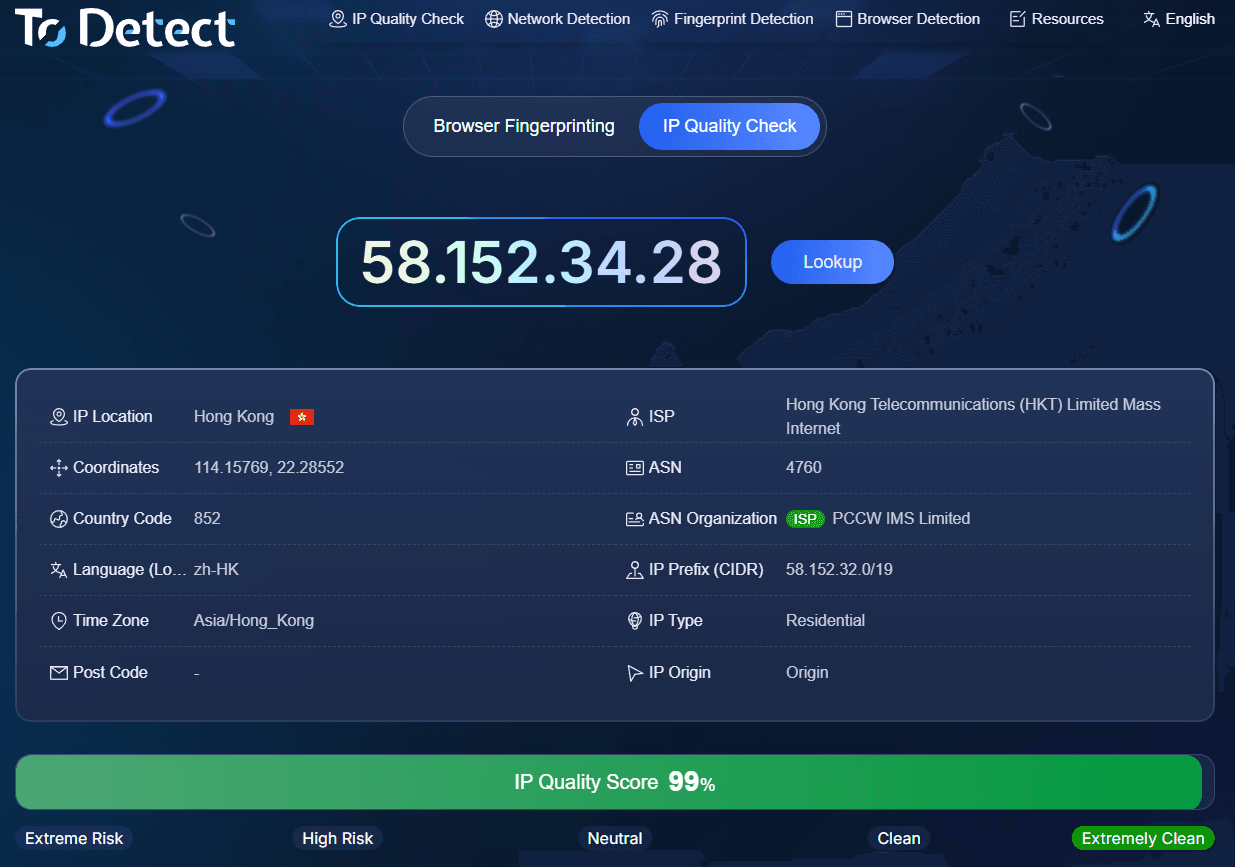
For instance, an IP may map geographically to the United States, but its ASN network, time zone, DNS resolution, or other network data show noticeable discrepancies. Security systems treat these mismatching attributes as potential risk indicators.
A thorough online IP check should simultaneously examine: location alignment, ISP and ASN consistency, residential vs. data center classification, and proxy indicators. Combining these elements provides a complete picture of why an IP score might be high.
6. How to Troubleshoot a High IP Risk Score
If your IP risk check yields a high risk level without blacklist records, follow this diagnostic sequence:
First, verify blacklist records for explicit historical abuse; next, review the IP type to distinguish between residential, mobile, enterprise, or data center networks; then, check the ASN and ISP to evaluate network source legitimacy.
A single minor anomaly does not automatically make an IP unusable. However, if multiple signals overlap—such as high risk ratings, active proxy indicators, unusual network types, and poor ASN reputation—exercise caution even if the blacklist count is 0.
7. IP Risk Score Check FAQ
1. Why does a newly purchased IP show a high risk score immediately?
"Newly purchased" does not mean unused. Previous traffic history, subnet reputation, ASN type, and proxy tags may still influence the score. Always analyze ASN, network type, and proxy attributes alongside blacklists.
2. Why did an IP show low risk yesterday but high risk today?
IP risk scores are dynamic. Detection databases continuously update usage logs, network assignments, and risk tags. Recent traffic anomalies can alter the rating quickly, making real-time checks more reliable than past results.
3. Why does a residential IP still show high risk on a proxy test?
A residential label merely indicates network classification, not absolute purity. If the IP is shared, rotated frequently, or located in a subnet heavy with proxy traffic, it can still trigger high risk warnings.
4. Different IP lookup tools show conflicting risk scores. Which one should I trust?
Variations are common due to differing data feeds, scoring algorithms, and update frequencies. Instead of relying on a single numerical score, use comprehensive tools like ToDetect to cross-examine blacklists, ASN reputation, IP types, and proxy traits.
Summary:
To accurately assess an IP address, perform a complete lookup using tools like ToDetect, analyzing IP type, ASN, ISP, proxy indicators, blacklists, and overall risk rating together.
An empty blacklist does not mean zero risk, nor does a high risk score mean the IP is blocked everywhere. Deconstructing the metrics reveals whether an IP is merely "clean with a strict rating" or carrying genuine network risks.
Next time you encounter a high risk rating on an IP without blacklist records, look beyond blacklists to review underlying network properties and historical reputation data.