Resources
 Feature overview

 Ganesh
 2026-07-02 11:44
Many people doing cross-border and multi-account operations often get stuck on a very “invisible” issue—whether an IP is clean or not. At first glance, they all look like a string of numbers, but in reality, the “identity” behind different IPs is completely different.
Especially in today’s increasingly strict risk-control environment, platforms no longer just check whether you have “changed your IP,” but directly determine whether you are using a static residential IP or a data center IP (datacenter IP).
Next, let’s take a look at how to distinguish static residential IPs from datacenter IPs, and how ordinary users can quickly identify them using proxy IP detection tools. Some details may be more critical than you think.

1. First, clarify: Static Residential IP vs Datacenter IP
A static residential IP is an IP address assigned by an ISP to a real home broadband user, and it usually remains unchanged for a long time. A datacenter IP, on the other hand, comes from cloud server providers or IDC data centers.
Simply put: static residential IP = real home network, stable and low risk control; datacenter IP = server network, fast but easier to detect.
2. Why IP type matters so much?
Many people ignore the “identity attributes” of IPs, but in many scenarios, it is actually a core factor for judgment, such as: cross-border e-commerce account registration and nurturing, social media account matrix operations, advertising account environments, and data scraping and automation scripts.
If you use a datacenter IP, you are more likely to encounter instant account bans, frequent verification, and abnormal login issues. Residential IPs, however, are much closer to real user behavior environments and have significantly higher success rates.
3. How to use Online IP Lookup to determine IP type?
Many online IP lookup tools today essentially determine results by integrating IP databases, ASN ownership, and historical behavioral data. Therefore, results are not just “location,” but also deeper network attributes.
A complete IP lookup result usually highlights ISP type and ASN information, which can directly determine whether the IP comes from a datacenter or residential broadband.
For example, if the result shows a local ISP residential broadband network (such as China Telecom, China Unicom, Verizon, etc.), it is usually a residential IP. If it belongs to AWS, Google Cloud, Azure, etc., it is most likely a datacenter IP.
4. How proxy IP detection tools further evaluate?
Compared to basic IP lookup, professional proxy IP detection tools use more complex risk-control models. They not only identify IP sources but also evaluate behavioral patterns and blacklist data.
For example, some systems analyze whether an IP is frequently switching users or being shared across multiple accounts to determine whether it is a proxy or high-risk exit node.
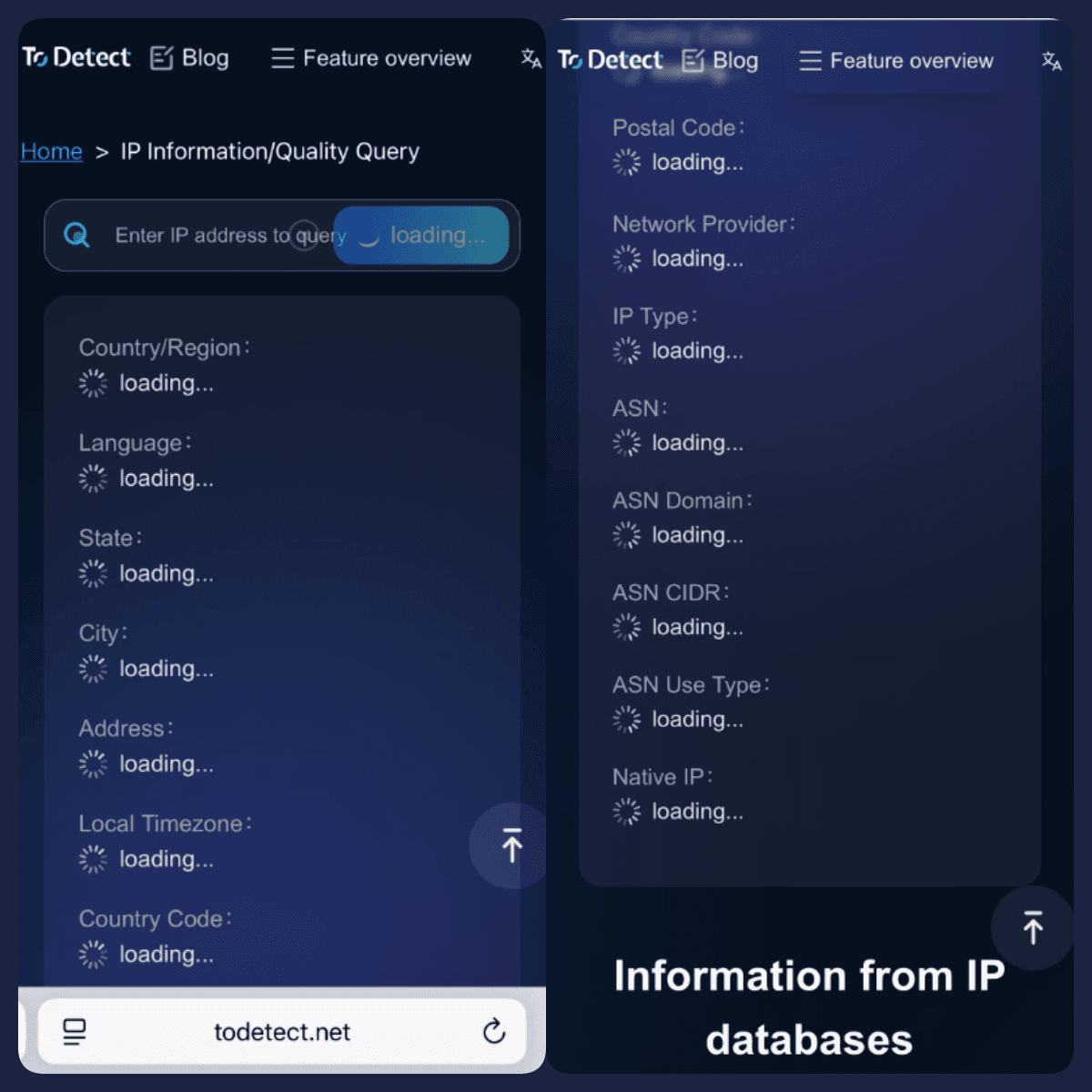
Tools like ToDetect typically provide risk scores or labels such as “Residential IP,” “Suspected Proxy,” or “High-risk Datacenter IP,” allowing users to quickly judge whether an IP is suitable for business use.
5. Static Residential IP vs Datacenter IP: quick identification tips
From a practical perspective, static residential IPs and datacenter IPs have quite obvious network differences, and can often be roughly identified even without tools.
First is IP distribution: datacenter IPs are usually concentrated in continuous ranges (cloud IP pools), while residential IPs are scattered across different regions and ISP networks.
Second is ASN and reverse DNS information: datacenter IPs often clearly show cloud provider identifiers, while residential IPs reflect local ISP information, and PTR records are relatively “clean.”
Finally, many advanced tools directly label IPs as “Datacenter” or “Residential,” which helps reduce misjudgment costs significantly.
6. Why more and more people use static residential IPs?
More and more people are doing overseas business, and demand for static residential IPs is increasing for practical reasons:
• Accounts are more stable and less likely to trigger risk control
• Closer to real user behavior
• Suitable for long-term operations (account nurturing, matrices)
• Much higher success rate than datacenter IPs
Especially on social platforms and advertising platforms where risk control is strict, IP quality often determines account survival.
7. How to choose a reliable IP Lookup method?
1. Prefer tools with frequently updated IP databases
Update speed directly affects accuracy. Slow-updating tools may misclassify new IPs as old types. This is especially important because cloud IPs change frequently.
2. Must support ASN and ISP parsing
Simply showing geographic location is not enough. A reliable IP lookup tool must parse ASN and ISP information, which can directly indicate whether it is residential or datacenter.
3. Proxy IP detection capability is essential
Many IPs appear normal but are actually used as proxy or VPN exits, so proxy detection is necessary to evaluate risk levels and avoid misjudgment.
4. Ability to label datacenter vs residential IPs
Good tools directly label “Residential IP” or “Datacenter IP” instead of leaving users to guess, greatly reducing misclassification.
5. Risk scoring system is more practical
Advanced tools provide risk scores such as blacklist status, shared usage, and abnormal behavior, which is more useful than a single result.
6. Clean UI and structured results
Although simple, this is crucial. Poorly structured results can lead to misinterpretation, while clear modular layouts improve efficiency.
Conclusion: Don’t just look at IP — look at its “identity”
Whether you are using a static residential IP or a datacenter IP is not just a technical difference in many systems—it represents “real user behavior” versus “bot-like behavior.” This is why some accounts remain stable while others get flagged immediately.
By using ToDetect online IP lookup and proxy IP detection tools, ordinary users can quickly determine the real nature of an IP instead of guessing.
In today’s internet environment, choosing the right IP often matters more than the operation itself. Understanding IPs and using them correctly can solve many account issues at the source.