Resources
 Feature overview

 Ganesh
 2026-09-15 10:40
When choosing a dedicated IP, many people subconsciously assume that since the IP is exclusively used by themselves, there shouldn't be any quality issues. In reality, "dedicated" does not equate to high IP quality, nor does it mean the IP has never been used in the past.
Therefore, whether you have just acquired a new dedicated IP or have been using one for a while, it is recommended to perform a comprehensive IP quality check first, rather than simply verifying if the IP can connect normally.
Next, let's look into what key items should be checked during a dedicated IP quality test and why some newly acquired dedicated IPs might still flag high-risk scores.

1. Why Can Dedicated IPs Still Show High Risk?
The term "dedicated" mostly implies that the IP is assigned to a single user during the current service period. However, relying on the word "dedicated" alone reveals nothing about what the IP experienced prior to delivery.
Additionally, database update speeds vary across different providers. It is quite common for the same IP to show low risk on one platform while flagging medium risk on another.
Therefore, taking a few minutes to conduct a full IP quality check after receiving a new IP is essential. If multiple online IP checking platforms report similar anomalies, further verification of the IP's actual status is recommended.
2. IP Quality Detection Step One: Check Basic Info Consistency
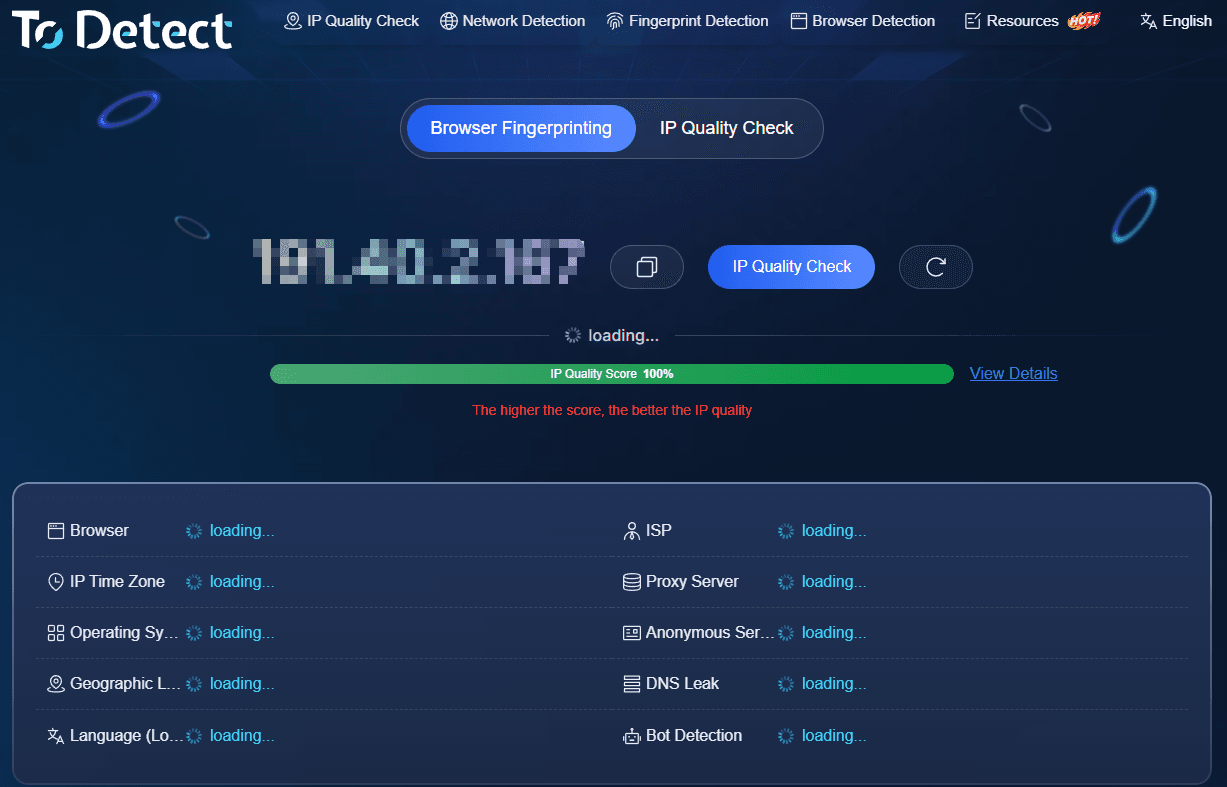
By using online IP checking tools like ToDetect, you should focus primarily on three questions:
First, is the country and region location consistent? If you purchased a US IP, but multiple databases report vastly different locations, further confirmation is needed.
Second, is the Internet Service Provider (ISP) information reasonable? Different IPs correspond to different network operators, and ASN details can help determine what type of network resource the address belongs to.
Third, does the IP type match your expectations? Some IPs may show no geographic discrepancies on the surface, but databases may classify their underlying network type differently.
When users search for terms like "online IP test", "online IP check", or "direct IP test", confirming these basic attributes for anomalies is usually their primary goal.
3. Don't Rely Solely on a Single Risk Score
Many IP quality check websites provide risk scores labeled as Low, Medium, or High, or represented by numbers ranging from 0 to 100. While these scores are helpful reference points, they should not be used as the sole basis for judgment.
This is because data sources, update frequencies, and scoring algorithms vary across platforms. Obtaining different results when querying the same IP on different websites is completely normal.
If only one database gives a slightly higher risk score while all other parameters are normal, you can keep monitoring it. However, if multiple IP quality test platforms report similar abnormalities, it warrants serious attention.
4. Dedicated IP Quality Check Requires Reviewing History
When a dedicated IP flags high risk, the problem often lies in its past usage rather than current activities. An IP address is a reusable network resource; being assigned to you today does not mean it was never used by someone else before.
If its prior history was complex or problematic, security databases, threat intelligence lists, or reputation systems may still retain historical records.
This explains why a newly acquired dedicated IP might display elevated risk flags during an online IP check even before you perform any operations.
Therefore, when testing a dedicated IP, pay extra attention to "historical reputation" rather than focusing exclusively on connection speed and latency.
A fast connection speed does not guarantee good quality. Conversely, an IP with slightly higher latency but clean historical records and clear basic attributes often delivers a more reliable user experience.
5. Inspect DNS and Browser Network Data Together
Checking IP quality involves more than entering an address and reading a risk score.
If the IP has already been configured in your active network environment, you should also check whether the DNS details, public IP reported by the browser, and network egress points match seamlessly.
When conducting an online IP check via ToDetect, combining IP details, DNS leaks, and environment detection provides a complete picture, making it far easier to pinpoint underlying issues compared to basic single-point IP checks.
6. Key Metrics to Determine if a Dedicated IP is High Quality
If you prefer to keep evaluation straightforward, keep these practical evaluation standards in mind:
First, verify whether the detected IP type matches what you purchased. Next, check if the country, region, ISP, and ASN information remain consistent. Then, evaluate if there are glaring conflicts among different IP threat databases.
Additionally, observe whether historical risk scores are elevated, whether location changes frequently, and if the network connection remains stable over continuous usage. A high-quality dedicated IP isn't defined by a single glowing metric, but by balanced performance across all indicators.
An IP with high speed but messy risk history cannot be considered high-quality; similarly, an IP with good risk scores but constantly shifting locations or network types requires further inspection.
7. IP Quality Detection FAQ & Troubleshooting
1. Why does a brand-new dedicated IP flag high risk immediately upon testing?
"Dedicated" only means you are the primary user currently; it does not guarantee the IP was never allocated in the past. If the IP has a complex usage history, certain IP quality databases may still retain old flags, causing high-risk scores on a newly acquired IP.
2. Why do different test websites show different risk scores for the same IP?
This is very common. Online IP detection platforms rely on distinct data sources, update cycles, and scoring models. An IP may show low risk on one platform and medium risk on another. It is best to judge holistically by combining IP type, historical records, ASN, and multi-database results.
3. Does a location discrepancy in IP quality checks mean the IP is problematic?
Not necessarily. IP geolocation relies on database mapping, not GPS tracking; minor variations between neighboring cities across platforms are normal. However, if the country, timezone, or continent differs drastically, you should investigate the ISP, ASN, and other IP metrics further.
4. If the IP risk score is low, why should I still check ASN and ISP?
Because the risk score is just one indicator in IP quality evaluation. ASN and ISP details reveal the network infrastructure and carrier behind the address. Even with a low risk score, significant discrepancies in network type, operator, or location warrant further verification.
Summary
To determine whether a dedicated IP is genuinely good, evaluate it comprehensively across IP type, location, ISP & ASN, risk scoring, historical reputation, DNS data, and cross-database results.
You can perform IP quality checks using online tools like ToDetect alongside other public databases. If you find a dedicated IP with an elevated risk score, don't focus solely on the "High Risk" label—first check which specific data point triggered the warning.
"Dedicated" addresses *who is using it*, while IP quality detection addresses *how good the IP itself actually is*. Separating these two concepts will give you greater clarity when selecting IPs and help you avoid unnecessary pitfalls.