Resources
 Feature overview

 Ganesh
 2026-09-16 10:57
When performing an IP Risk Score Check, many people see the "Risk Score" in the detection results and their first reaction is: What exactly does this score represent? How much is considered high? Does a high score mean this IP is completely unusable?
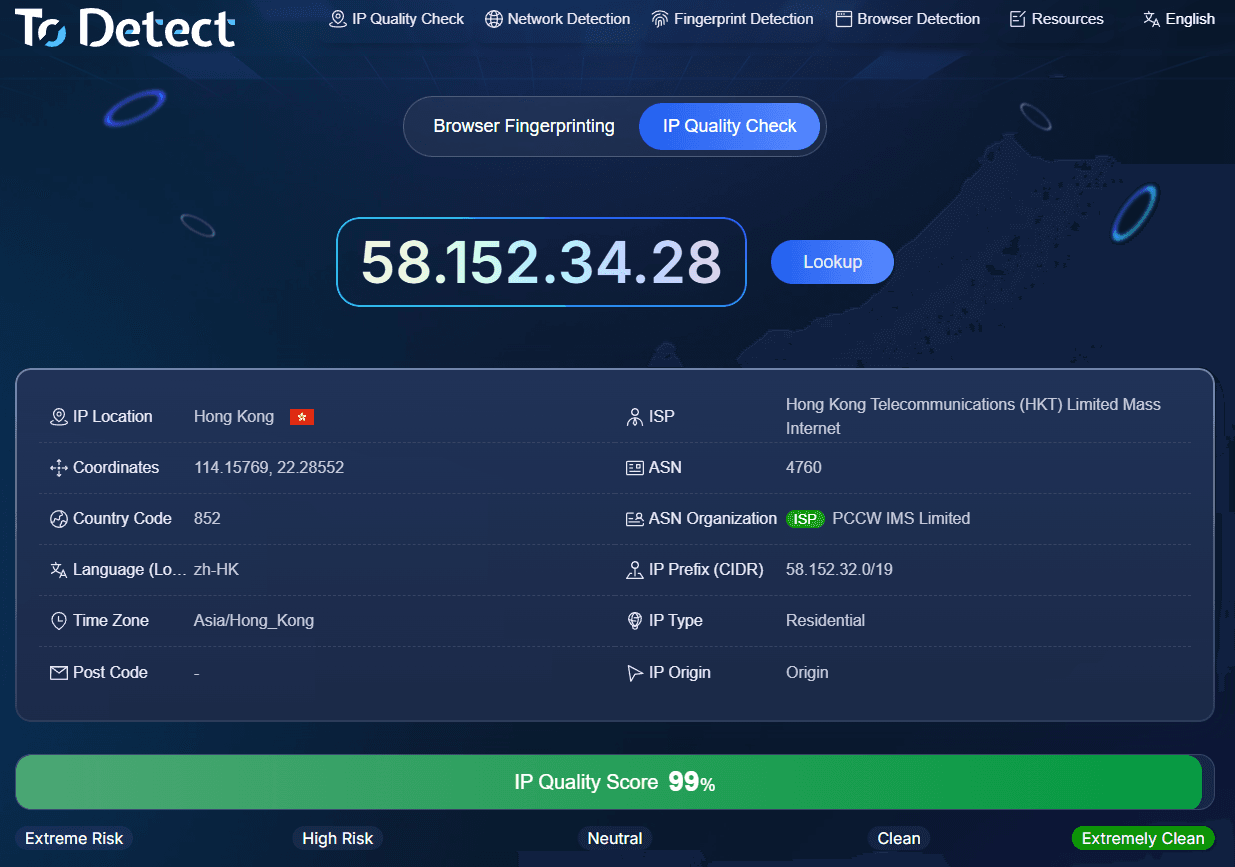
In fact, an IP risk score is more like a "network reputation reference." It combines information such as IP type, ISP, ASN, historical logs, and blacklists to make a comprehensive judgment on the risk level of the current IP.
It is worth noting that the risk score is not investigating who is behind the IP address, but rather evaluating whether the IP itself exhibits obvious abnormalities or risk characteristics. Below, we will clarify this across several aspects: scoring criteria, how to interpret the score, and practical usage scenarios.

1. The Bottom Line: What Does an IP Risk Score Check Actually Look For?
An IP risk score check essentially aggregates information like blacklists, IP types, ISPs, and historical records to evaluate and provide a single risk score.
For instance, if you are using a Data Center IP, the database recognizes immediately that it is not standard residential broadband, automatically increasing its risk weight. The conclusion is straightforward: It doesn't care who you are—it only cares whether your egress point is "clean."
2. How is the IP Risk Score Calculated?
While scoring rules vary across different tools, the underlying logic is largely consistent and revolves around the following core factors.
2.1 Blacklist / Spam Database Matches (Public Blacklists, DNSBL/RBL)
This is the most fundamental criteria. If your IP appears on public blacklists (such as real-time DNSBL/RBL lists), your score instantly spikes. Many mail servers and registration endpoints query these databases as a first line of defense. In short, these lists act as a "prior record."
2.2 IP Geolocation & ISP Alignment (ISP/ASN Consistency and Expectations)
The system verifies whether the IP registration location, ISP, and ASN are reasonable. For example, if you are located domestically but your egress IP indicates an obscure subnet from a small ISP—or if the ISP and ASN mismatch—the database flags a red flag. In cross-border networking, geolocation mismatches against expectations frequently trigger fraud controls.
2.3 IP Type: Residential / Data Center / Proxy Egress / Tor
This factor is critical. Residential IPs are generally considered the "safest," followed by Data Center IPs, while proxy nodes and Tor exit points naturally carry a "potential abuse" tag. Using a proxy node doesn't automatically mean danger, but algorithms assign a higher default risk weight to these egress types.
2.4 Historical Behavior & Reputation Records (Past Scanning, Abuse, Reports)
Databases also check past records: Has this IP engaged in massive port scanning, been reported for abuse, or generated spam traffic in the past? Reputation takes time to build, and so do bad marks.
3. What Score is Considered "High"? Understanding the 0–100 Scale
3.1 Standard Score Intervals (Low / Medium / High General References)
The general reference scale ranges from 0 to 100, where higher scores indicate higher risk. Generally, 0–30 is considered Low Risk (relatively clean), 30–70 is a Moderate Zone (depends on specific attributes), and 70+ is categorized as High Risk by most systems. Note: This is only a reference scale and not an absolute threshold—do not treat it as a definitive "death sentence."
3.2 Why Do Results Vary Across Different Checkers? (Data Sources, Update Frequency, Algorithm Weights)
It is common to see a score of 20 on Site A and 65 on Site B. This is completely normal. Different databases cover different blacklists, update at different frequencies, and assign different weights to attributes. Some prioritize email blocklists, while others weigh proxy tags heavily. Thus, there is no single answer to "what score is considered high"—it depends on which database is evaluating your IP.
4. Where Are High-Risk IPs Most Vulnerable to Blocking?
4.1 Account Registration & Login Security Controls (New Accounts / Batch Registrations)
A common pitfall: You sign up for an overseas platform, only to receive a "Risk Detected" prompt right after submitting your info. The backend system likely flagged your egress IP score—especially if batch registrations originate from Data Center IPs.
4.2 Cross-Border Business & Platform Access (Regional Restrictions, Risk Engine Verification)
Cross-border operators know this well. If an egress IP is tainted or doesn't match the expected region, anti-fraud systems will prompt repeated CAPTCHAs or block access entirely. Often, the issue isn't the account itself, but a lack of network environment consistency.
4.3 Email Deliverability (Spam Folders and Bounces)
If you send emails from a blacklisted IP, your messages will likely disappear into thin air. Receiving servers detecting a high-risk sending IP will either route emails directly to the spam folder or reject them entirely.
5. How to Perform a Reliable IP Risk Score Check
5.1 Look Beyond the Single Number: Evaluate IP Type, ISP, and Egress Attributes
Do not rely solely on the numerical score. A score of 50 on a Residential IP means something completely different than on a Tor exit node. Always inspect the IP Type, ISP, and proxy attributes together to determine if the score is justified.
5.2 Adopt a Multi-Source Cross-Verification Strategy
False positives in a single database are common. The best practice is cross-referencing multiple sources: If Database A flags high risk while Database B reports normal, it is likely a localized false positive. Additionally, DNS health is vital—running a DNS leak test helps verify if your resolution egress is exposed.
6. Common Misconceptions About IP Risk Score Checks (FAQ)
6.1 "Is a low risk score guaranteed to be safe?"
Not necessarily. A low score simply indicates that no obvious red flags were found in the current database. It does not guarantee the IP was never misused, nor does it guarantee security engines will bypass it. Scores are references only.
6.2 "Are Data Center IPs always high risk?"
No. Data Center IPs simply carry a higher default baseline weight. Many legitimate services (e.g., corporate servers, official proxies) use them. Actual risk depends on specific historical activity logs.
Conclusion
To summarize: An IP risk score is a reference point, not a final verdict. Evaluations vary across databases, and real-world results depend on specific platform rules and overall network consistency. Running an IP check before deploying proxy IPs or setting up a new network environment helps identify obvious issues early on.