Resources
 Feature overview

 Ganesh
 2026-05-25 11:23
Nowadays, risk control on major platforms is becoming increasingly strict. Whether it's Amazon, eBay, or TikTok Shop, once the system determines that your account environment is “unclean,” the consequences can range from traffic restrictions to permanent account suspension.
One of the most critical factors behind this is — IP purity. Many people have heard of this term, but not everyone truly understands its impact.
Today, let’s talk about what IP purity actually is, why cross-border eCommerce platforms care so much about it, and what we can do to better reduce account risks.

1. What Is IP Purity ? Why Is It So Important?
IP purity refers to whether an IP address is “clean,” whether it has been frequently used by multiple users, and whether it has been flagged for risky behavior by platforms.
Many platforms (such as Amazon, eBay, TikTok Shop, Shopee, etc.) use IP addresses to evaluate account environments.
If multiple accounts use the same IP, or if the IP itself has suspicious records, it can easily trigger account association detection mechanisms, resulting in traffic limitations or even permanent bans.
This is especially important for sellers managing multiple stores or operating account matrices, where proper IP isolation is crucial to avoid accounts being linked together.
2. The Core of Account Anti-Association: Not Just IP, But the Entire Environment
Many people think changing an IP is enough for security, but that’s far from true. Real account anti-association is a systematic issue that includes:
• Whether the IP address is independent
• Whether browser fingerprints are consistent (browser fingerprint detection is extremely important)
• Whether cookies and cache are shared
• Whether device information is duplicated
• Whether login behavior appears abnormal
Among these, IP is only the first layer of protection. If the IP itself is not clean, even a perfect environment setup may still be identified by the platform.
3. Common IP & Environment Types in Cross-Border eCommerce: Risk Comparison Table
| Type | Usage Method | Stability | Risk Control Probability | Suitable Scenarios | Recommendation |
|---|---|---|---|---|---|
| Datacenter IP | Common in cheap proxies/VPS | Low | Very High | Testing, temporary login | Not recommended for main accounts |
| Shared Proxy IP | Multiple users share the same IP pool | Relatively Low | High | Short-term operations | Easily triggers account association |
| Dedicated Proxy IP | One IP per account | Medium-High | Medium | Early-stage store operations | Can be used as a transitional solution |
| Residential IP (Real Home Network) | Home networks assigned by ISPs | High | Low | Main account operations | Highly recommended for cross-border eCommerce |
| Mobile Network IP | Dynamic 4G/5G IP | Relatively High | Relatively Low | Temporary login, mobile office | Average stability |
| Dynamic Broadband IP | Home broadband with changing IPs | Medium | Medium | Daily operation support | Maintain login environment consistency |
4. How to Determine Whether an IP Is Clean ? The Key Lies in Detection
In practice, many sellers use various tools for evaluation, such as:
• Online IP lookup
• IP purity detection
• IP quality checks
• These tools help quickly determine whether an IP is residential, polluted, or blacklisted.
Especially when registering stores in batches or changing operational environments, it’s highly recommended to conduct IP quality checks first to avoid future account issues and losses.
5. Why Cross-Border Sellers Increasingly Rely on IP Detection Tools
As platform risk control becomes stricter, manual judgment is no longer practical. More sellers now rely on tools like ToDetect for environment analysis:
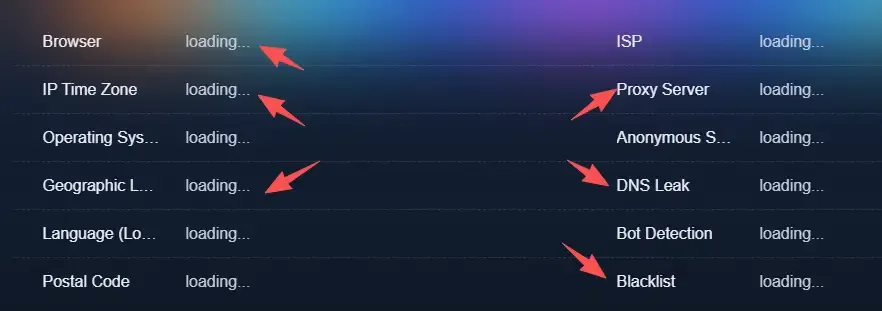
• IP purity detection
• Browser fingerprint detection
• WebRTC leak detection
• DNS information analysis
• Proxy environment identification
For sellers operating multiple cross-border eCommerce accounts, these functions can significantly reduce trial-and-error costs.
6. Why Browser Fingerprint Detection Is Just as Important as IP
Many people only focus on IPs while ignoring browser fingerprint detection. In reality, modern platform risk control systems are highly advanced, and IP alone is no longer enough.
• Browser fingerprints include: screen resolution, font environment, plugin information, operating system version, Canvas/WebGL fingerprints.
• If multiple accounts “look too similar,” they may still be identified as being operated by the same person even with different IPs.
Therefore, the safest approach is: IP isolation + fingerprint isolation for dual-layer protection.
7. Common IP Problems & Risk Scenarios in Cross-Border eCommerce
▽ Using cheap shared proxy IPs: Many sellers use low-cost shared proxies to save money, but these IPs are often repeatedly used by many users and may already be included in platform risk-control databases, making account bans highly likely.
▽ Multiple accounts logging in under the same network environment: If several store accounts are consistently operated under the same IP or network, platforms can easily identify them as belonging to the same operator.
▽ Frequently switching proxy nodes: Constantly changing proxy routes can lead to abnormal geographic IP jumps, which platforms may identify as suspicious activity.
▽ Using polluted IP ranges: Some IPs may still function normally, but their history may include large numbers of违规 accounts, resulting in hidden risk-control dangers.
▽ Registering accounts without checking IP purity: Many beginners skip online IP checks and IP purity testing before account registration, causing unstable operations from the very beginning.
▽ IP and browser fingerprints do not match: Even if an IP appears normal, inconsistencies between browser fingerprint data and IP region/device environments can still trigger account association detection.
8. Practical Suggestions: How to Build a Safe Account Environment
△ Prioritize dedicated residential IPs or high-quality proxy IPs: Choose stable residential IPs or reliable proxy resources to reduce risks caused by polluted or shared IPs.
△ Keep each account in an independent browser environment: Use isolated browsers or environments to completely separate cookies, cache, and account data.
△ Regularly perform IP quality checks and environment testing: Conduct checks before launching and during operations to ensure your IP has no abnormal records or risk flags.
△ Run IP purity detection before registration: Avoid using “dirty IPs” during account creation to prevent operational restrictions later.
△ Avoid frequently switching network nodes: Maintain stable IP environments and avoid rapid proxy switching that could trigger abnormal login detection.
△ Use browser fingerprint isolation tools together: Combine browser fingerprint detection and isolation tools to keep device fingerprints, timezone, and language settings consistent yet independent.
Conclusion
In cross-border eCommerce, long-term competition is often less about operations and product selection, and more about account environment stability and security.
Making good use of online IP lookup tools, IP purity detection methods, and professional tools like ToDetect can help you avoid many unnecessary pitfalls.
Once you build a solid foundation for account security, you’ll notice significant improvements in account stability, giving you greater confidence for scaling operations and advertising campaigns.