Resources
 Feature overview

 Ganesh
 2026-07-10 15:53
In the fields of cross-border e-commerce, streaming media unblocking, and multi-account management, the quality of IP addresses directly determines business success or failure.
When choosing servers or proxy IPs, many users frequently come across the concept of a "Native IP."
This article delivers an in-depth analysis of what Native IPs are, how they differ from Broadcast IPs, and how to perform effective Native IP detection to help you secure higher-quality network resources.

What is a Native IP?
A Native IP, also known as a local IP, refers to an IP address whose registered country perfectly matches the physical country where the data center is located.
These are authentic, publicly routable IP addresses directly allocated to local network service providers by Regional Internet Registries (RIRs) such as APNIC or RIPE.
Native IPs exhibit the following key characteristics:
Clean Location Data: The country code and ISP name in the WHOIS data align perfectly with the actual physical location of the data center.
High Trust Scores: Because they are recognized as genuine local users or local data centers, they easily bypass strict regional risk controls, such as those implemented by streaming platforms (Netflix, Disney+) or localized gaming servers.
Stable Performance: They generally offer lower latency, higher bandwidth, and more direct backbone network connections.
Native IP vs. Broadcast IP
The opposite concept is a Broadcast IP (Non-Native IP). This happens when an IP's registered location does not match its physical data center location; providers use technical routing methods to "broadcast" an IP block from another region into the current data center.
While proxy IPs are just a technical means of relaying network traffic, their underlying network resources are still fundamentally categorized into native vs. broadcast, and residential vs. datacenter.
Furthermore, what people commonly call Residential IPs are the highest-reputation tier of Native IPs. Allocated by residential ISPs to home broadband users, they are viewed by anti-fraud systems as practically identical to real human users.
Conversely, Datacenter IPs are provided by cloud hosting companies. Even when they are native, their inherent risk scores and sensitivity to anti-fraud systems remain higher than those of residential IPs.
Why Do You Need Native IP Detection?
When buying proxy IPs or renting VPS servers, relying blindly on a provider's verbal promises is a recipe for trouble. Native IP detection helps you mitigate the following risks:
Incomplete Streaming Unblocking: While native IPs improve your odds of unblocking platforms like Netflix, if the IP type is flagged as Hosting (Datacenter), the platform might still block it entirely or restrict you to originals-only content.
Account Bans and Flags: Cross-border e-commerce platforms (such as Amazon and eBay) scrutinize IP types rigorously. Using an IP flagged as non-local or high-risk datacenter for account farming highly triggers account linking or suspensions.
Excessive Fraud Scores: Professional tools can assess an IP's fraud rating. Scores under 50 are generally considered safe; anything higher can lead to failed account registrations or frequent connection blocks.
How to Determine If an IP Is Native
Verify WHOIS Data: Check if the registered country code in the IP's WHOIS data matches the physical location of the data center.
Cross-Reference Major GeoIP Databases: Use authoritative geographic location databases like MaxMind, IPinfo, and IP2Location to ensure the IP's location mapping hasn't drifted across different registries.
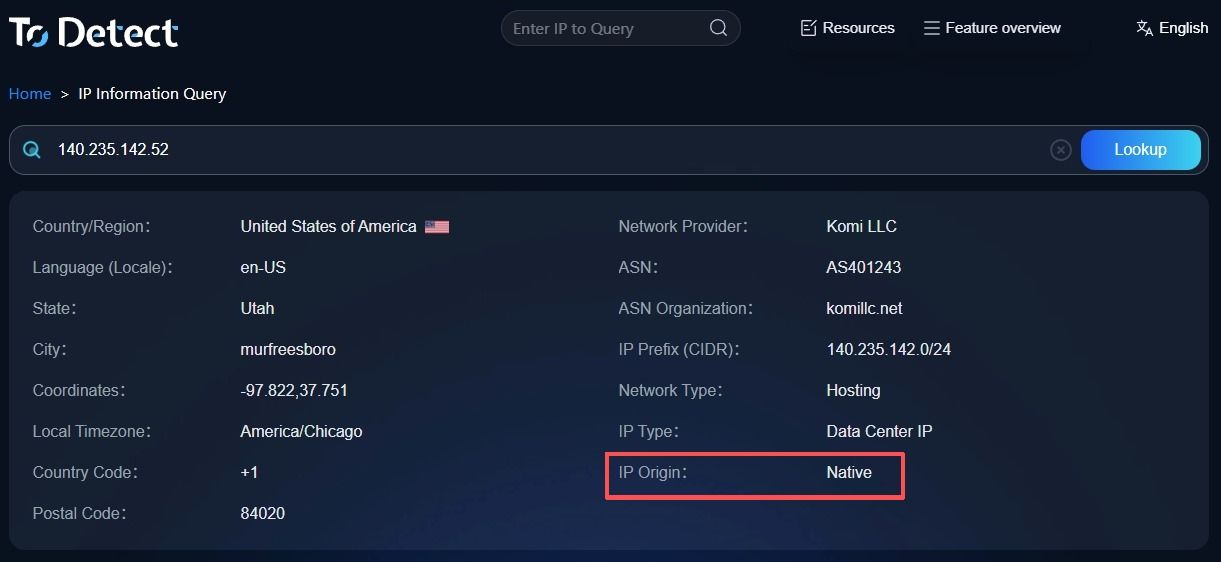
Utilize Specialized Third-Party Tools: For example, on the ToDetect platform, you can check if an IP source is "Native" with a single click and instantly retrieve detailed Internet Service Provider (ISP) datasets.
Frequently Asked Questions (FAQ)
Q1: Does a Native IP guarantee unblocking Netflix?
Not necessarily. A Native IP is merely the baseline requirement. Platforms like Netflix strictly filter out datacenter IPs; even a native datacenter IP might only grant access to Netflix-produced originals.
For flawless unblocking, it is best to opt for a native residential IP that hasn't been blacklisted by the platform.
Q2: Are Native IPs more expensive than Broadcast IPs?
Generally, yes. Native IPs are scarce resources with higher trust equity and compliance advantages, making their acquisition and maintenance costs higher than those of broadcast IPs.
Q3: Do I need a Native IP for a basic personal website?
No. For standard web hosting, visitors care primarily about loading speeds and uptime. Broadcast IPs perform nearly identically to native ones in terms of raw network metrics, so a cost-effective broadcast IP is perfectly fine.
Q4: How can I minimize the risk of proxy IPs getting banned?
Always run a purity check before deploying any proxy IP. We highly recommend picking native residential IPs with low fraud scores and accurate locations, and using ToDetect for routine IP inspection to guarantee that your operational environment aligns perfectly with your IP's geolocation.
In complex online environments, performing regular native IP audits is a foundational step—whether you are looking to secure business operational stability or shield your accounts from bans.
If you require a comprehensive IP profile report, please visit the ToDetect Official Website for professional analytics.