Resources
 Feature overview

 Ganesh
 2026-05-21 10:56
In the past, many people involved in cross-border business only cared about whether an IP could be used. Now, they care more about “whether the IP quality is high,” “whether it will trigger risk control systems,” and “whether the account will become abnormal.”
Especially in the past two years, platforms like Google, Facebook, and TikTok have become increasingly strict. Without conducting IP purity checks in advance, accounts can easily face traffic restrictions or login abnormalities.
Next, let’s talk about what online IP quality checks are actually used for, how to understand IP risk scores, and how to properly perform quality checks and testing for proxy IPs online.

1. Why Are More and More People Paying Attention to IP Purity Detection ?
In the past, many users believed that as long as an IP could open a webpage, it was considered a “normal IP.” But today, platform risk control mechanisms have completely changed.
□ Platforms like Google, Facebook, TikTok, and Amazon comprehensively evaluate:
□ Whether the IP is a proxy IP, whether the IP has abnormal historical behavior, whether regions are switched frequently, whether the browser fingerprint is stable, and whether there are signs of bulk account registrations.
Many people still get banned even after using proxies. In many cases, the issue is not IP failure, but poor IP quality.
2. What Can Online IP Quality Checks Actually Detect?
Professional IP quality testing tools usually analyze an IP from multiple dimensions.
1. IP Risk Score
IP risk scores are calculated based on blacklist records, abnormal traffic history, proxy behavior, data center attributes, and spam request frequency.
The higher the risk score, the more likely the IP is to trigger platform risk controls. Many platforms internally use similar mechanisms.
For example, some IPs may still allow account login but frequently trigger secondary verification, email verification, mobile verification, or login protection. Essentially, this indicates a high IP risk level.
2. Proxy IP Detection
Many platforms now actively identify proxy IPs. In particular, data center IPs, public proxies, server nodes, and bulk exit IPs are closely monitored.
Some people still believe that “using a foreign IP is enough to stay safe.” In reality, if the IP has already been shared by tens of thousands of users, platforms can easily recognize it.
In the eyes of platforms, high-quality residential IPs and ordinary data center IPs are vastly different.
3. IP Purity Detection
Simply put, this checks whether the IP has a “clean” history.
□ For example, whether it has been used by a large number of accounts, whether it has violation records, whether it appears in risk control databases, or whether it has been reported — all of these affect IP purity.
□ High-purity IPs usually encounter fewer CAPTCHAs, provide more stable logins, offer safer ad accounts, and result in more durable social media accounts.
Therefore, many people engaged in overseas business perform IP purity checks before officially using an IP.
3. Common IP Detection Items and Corresponding Risks
| Detection Item | Main Detection Content | Common Risks |
|---|---|---|
| Online IP Quality Check | IP reputation and historical behavior | Login abnormalities and risk-control interception |
| IP Purity Detection | Whether blacklist records exist | Account association and traffic limitation |
| IP Risk Score | Comprehensive risk level evaluation | Frequent CAPTCHAs and account bans |
| Proxy IP Detection | Data center IP identification | Platform detection of proxy environments |
| Browser Fingerprint Detection | Browser environment consistency | Fingerprint anomalies and account abnormalities |
| DNS / WebRTC Detection | Whether the real IP information is leaked | Exposure of real network identity |
| ToDetect Environment Detection | Comprehensive environment credibility analysis | Reduced account stability |
4. How to Choose a Reliable Online IP Quality Check Tool?
There are many tools on the market today, but it is recommended to focus on several key dimensions.
□ Whether it supports real proxy IP detection
Advanced risk-control systems can identify residential proxies, ISP proxies, data center proxies, and mobile proxies. The more detailed the detection capability, the more valuable the results.
□ Whether it supports browser fingerprint detection
Today, IP is only one part of platform risk control. Browser fingerprint consistency, DNS, WebRTC, Canvas, and timezone environments must also be analyzed together.
□ Whether it includes an IP risk scoring system
The more detailed the risk score, the better users can avoid issues in advance. Especially for long-term account operations, high-risk IPs should be avoided whenever possible.
5. Which Industries Need IP Risk Score Detection the Most?
Currently, the industries using online IP quality check tools the most are mainly concentrated in several sectors.
Cross-Border E-Commerce
• Platforms such as Amazon, eBay, and Shopee are extremely sensitive to IP environments. Many store association issues are essentially caused by IP and fingerprint exposure.
Social Media Operations
• Platforms such as Facebook, TikTok, and Instagram are becoming increasingly strict in identifying proxy environments.
• Low-quality IPs can easily lead to traffic restrictions, ad disapprovals, account abnormalities, and frequent login verification requests. Advertising accounts actually have very high requirements for IP purity.
• Especially for Google Ads and Facebook Ads, once the IP risk becomes too high, account stability will decline significantly.
Data Collection and Web Crawling
• Poor IP quality can easily result in IP bans, CAPTCHA challenges, and access restrictions. Therefore, conducting IP quality checks in advance can greatly reduce invalid requests.
6. Why Are Tools Like ToDetect Becoming Popular?
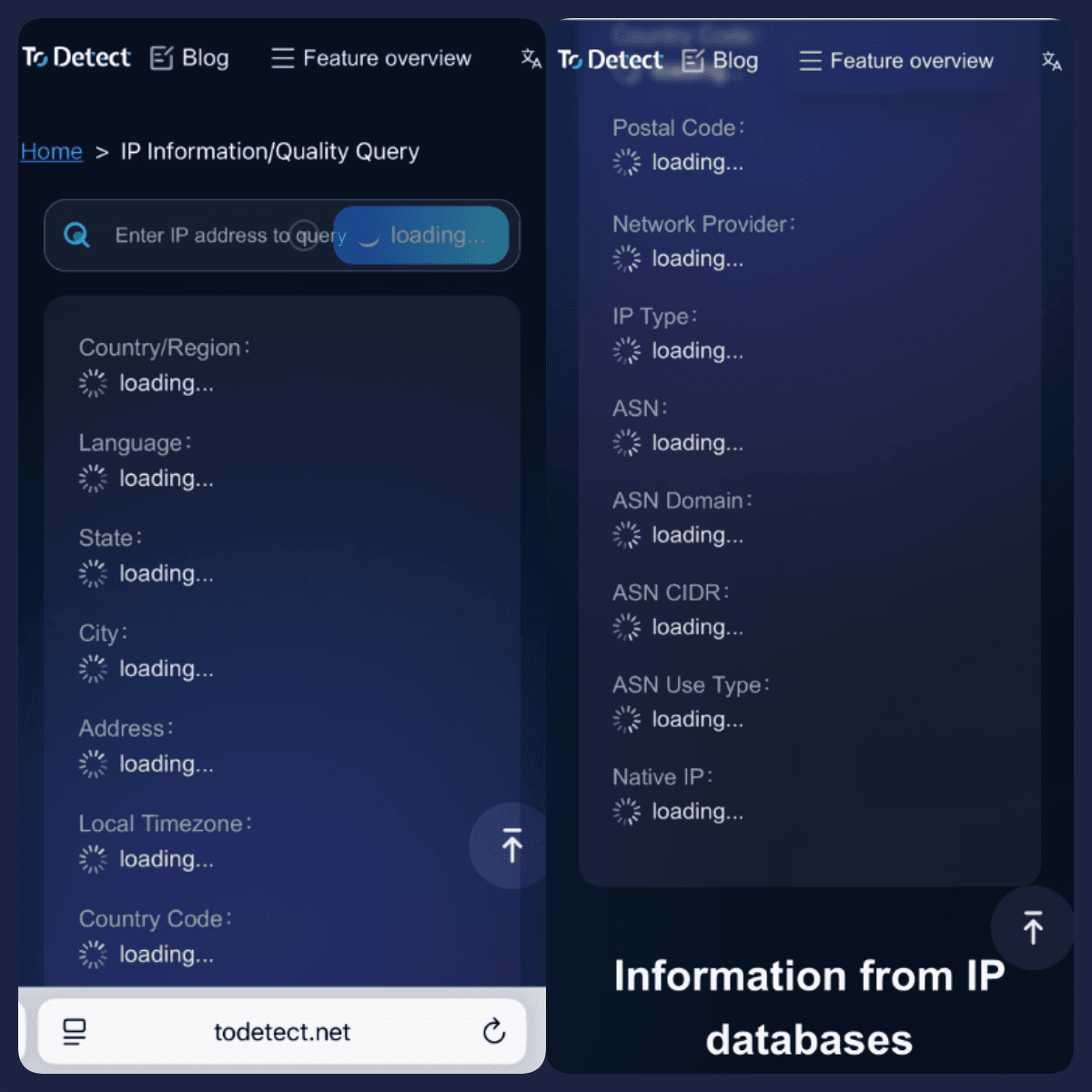
In the past two years, more and more people have started using online IP quality check tools like ToDetect because many traditional detection websites.
Only display IP geolocation, network provider information, and basic proxy status, while the factors that truly affect account security often cannot be detected.
Tools like ToDetect focus more on simulating real risk-control environments, including IP risk scores, proxy recognition probability, browser fingerprint anomalies, and DNS leaks.
For cross-border e-commerce, independent websites, affiliate marketing, and social media matrix operations, this type of detection has gradually become a necessity.
7. Frequently Asked Questions About IP Quality Detection (FAQ)
1. Why Do Accounts Still Get Banned Even When Using Proxy IPs?
Many users think that “changing the IP is enough to stay safe,” but platforms today not only detect IPs, they also analyze browser fingerprints, time zones, DNS, and other information simultaneously.
If the proxy IP quality is poor, the IP risk score is too high, or the browser fingerprint appears abnormal, the system may still classify the environment as high-risk even if account login succeeds.
2. Is IP Purity Detection Really Necessary ?
Absolutely. Many IPs may still access websites normally, but they may already have been heavily used by many users or even have violation histories.
Such IPs can easily trigger frequent CAPTCHAs, login abnormalities, and social media traffic restrictions. Therefore, screening low-risk IPs in advance can reduce the probability of account issues.
3. What Is the Difference Between Residential IPs and Data Center IPs? Which Is Safer?
Residential IPs are real home network IPs, so platforms usually regard user behavior as more natural. Data center IPs, on the other hand, are more easily identified as proxy environments.
Generally speaking, residential IPs offer higher stability and are more suitable for account operations, while data center IPs are faster but carry higher risk-control risks.
For cross-border e-commerce, social media marketing, and advertising campaigns, high-purity residential IPs are usually the safer choice.
Final Thoughts
Simply relying on “changing IPs” is no longer enough to solve account security issues. What truly determines environment stability is often the quality, purity, and overall network fingerprint behind the IP.
The reason why tools like ToDetect are gaining attention is because they can analyze the current account environment from multiple dimensions and help users reduce account abnormalities and risk-control probability.
Before officially operating an account, performing an online IP quality check and testing the environment in advance is far more time-saving than dealing with account bans later.